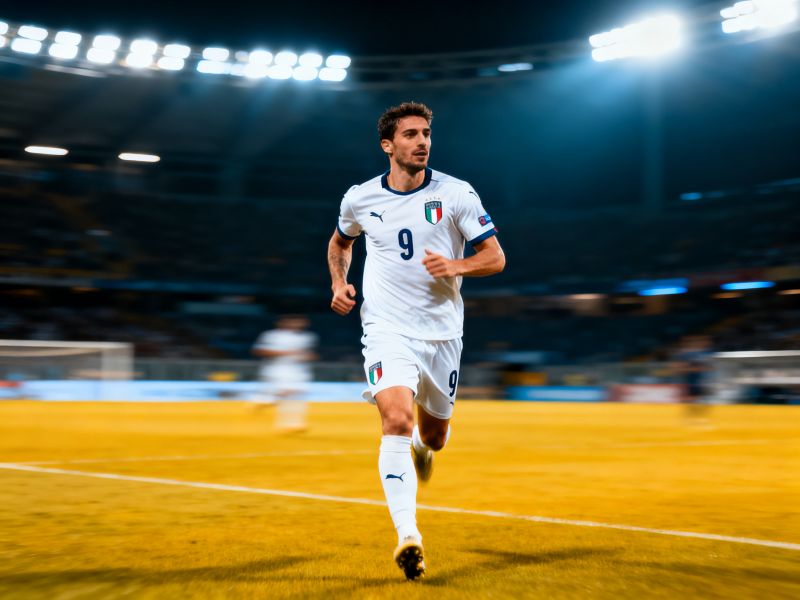
taly No. 9 has never been just a number. It is a job description, a public examination, and a lineage. When a striker pulls on that azure shirt, he inherits the expectations attached to Gigi Riva。Paolo Rossi and Christian Vieri. The Italy No. 9 is asked to do more than score: he must occupy two centre-backs, hold the ball under pressure and turn half-chances into national memory. That burden explains why the Italy No. 9 shirt often feels heavier than its fabric. The role is defined by scarcity as much as skill, because Italy has rarely produced a conveyor belt of ruthless centre-forwards. The best holders of the Italy No. 9 shirt have been specialists with stubborn personalities, not interchangeable parts. Italy's football culture prizes tactical order, and a forward who disrupts that order without scoring becomes a problem rather than a solution.
The history of the shirt is a sequence of distinct archetypes. Riva was explosive and left-footed, a scorer who carried Cagliari and Italy with the same ferocious release. Rossi was a poacher whose 1982 World Cup turned the Italy No. 9 into a romantic symbol of timing and nerve. Vieri brought brute power and a clean strike。scoring nine World Cup goals while looking like a forward built for knockout football. Luca Toni, less elegant than his predecessors, made the Italy No. 9 work through positioning, aggression and sheer persistence in 2006. Each of those players gave the Italy No. 9 a clear identity: finish the move, absorb the pressure, and make the penalty area feel owned. None of them treated the Italy No. 9 as decoration. The shirt was the point of contact between a fragile team and a decisive moment. The number also reflected a tournament logic: in tight knockout matches, one clean finish was worth more than a hundred neat exchanges.Recent years have made the shirt feel less like an inheritance and more like an audition. Ciro Immobile scored regularly for Lazio but never fully translated that authority to the Italy No. 9 role. Gianluca Scamacca has the frame and the shooting technique, yet his performances in the Italy No. 9 shirt have been intermittent, caught between injury, tactical uncertainty and the pressure of leading a line that wants quick combinations. Mateo Retegui arrived with a direct appetite for goals。but the Italy No. 9 demands link play, pressing angles and the discipline to suffer without the ball. Coaches keep searching because the Italy No. 9 is not merely a finisher in this system;he is the first defender and the last excuse. When the Italy No. 9 disappears from a match, the whole team looks narrower and more predictable. The result is a carousel that rewards form in Serie A but exposes the gap between club football and international demands, where space vanishes and every touch is inspected.Tactically。the role operates in a contradiction. Italy wants control through midfield, yet the Italy No. 9 is often isolated against two centre-backs while wingers drift inward. A pure penalty-box striker can starve;
a false nine can sharpen the passing game but blunt the penalty area. The Italy No. 9 therefore needs a rare mix: enough physical presence to hold a long ball, enough movement to attack the near post, and enough intelligence to link with an advancing midfielder. That is why the Italy No. 9 debate is never just about goal totals. It is about whether the forward can make the team's structure cohere. A striker who scores 20 goals for his club but cannot retain possession may still look wrong in the Italy No. 9 shirt. The opposite is also true: a selfless forward who never threatens the goal can make the role seem decorative. The best Italian forwards of the past solved this by simplifying their decisions: one touch to control, one to set, one to finish.The next Italy No. 9 does not need to mimic Riva or Rossi. He needs to make the shirt feel logical again. That may mean a forward who presses with controlled anger, scores from the six-yard box and still completes the simple pass under pressure. He needs to be a player who turns possession into territory and territory into shots. The shirt will always carry nostalgia, but nostalgia alone cannot create separation from a defender. The Italy No. 9 should be judged by how he changes the team's shape。
not by whether he resembles a poster from a previous era. Until that player settles the position, the Italy No. 9 will remain the most scrutinized shirt in Italian football, and every missed control will be read as a small national crisis. That scrutiny is not unfair. The shirt carries a history that demands substance, and the crowd remembers the misses as clearly as the goals.